
Buy Fire Extinguishers Online — Australia’s Specialist Supplier
Save up to 50% on service provider prices.


SHOP WITH CONFIDENCE
Shopping with us is safe and secure. Guaranteed!
SAFE SHOPPING GUARANTEE
All information is encrypted and transmitted using SSL protocols.
NEED HELP?
Contact our sales team. Email Us.
Best Selling Products
-
4.5kg Dry Chemical Fire Extinguisher
Original price was: $130.00.$57.00Current price is: $57.00. -
9kg Dry Chemical Fire Extinguisher ABE
Original price was: $187.00.$90.00Current price is: $90.00. -
2.5kg Dry Chemical Fire Extinguisher ABE
Original price was: $104.50.$45.00Current price is: $45.00. -
1kg ABE Fire Extinguisher — Home, Car & Caravan
Original price was: $49.50.$39.00Current price is: $39.00.

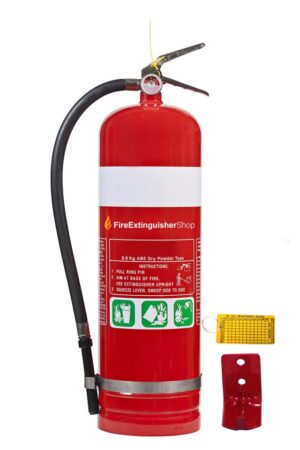


Fire Extinguisher Shop is Australia’s specialist online supplier of portable fire extinguishers and fire safety equipment. We stock dry chemical, CO2, wet chemical, foam, and water extinguishers — all compliant with AS/NZS 1841 — with fast delivery to every state and territory. Prices start from $26.90.
Whether you’re protecting a home, commercial kitchen, office, warehouse, or vehicle, we’ll help you find the right extinguisher for your specific fire risk. Every product we sell meets Australia’s mandatory safety standard — the Consumer Goods (Portable Non-aerosol Fire Extinguishers) Safety Standard 2021, which references AS/NZS 1841 directly.
Find the Right Fire Extinguisher
Choosing the wrong extinguisher can make a fire worse. The type you need depends on the fire risks in your environment — the fuel source, the location, and the size of the area you need to protect. Here’s a plain-English guide.
Fire extinguisher types at a glance
| Environment | Recommended type | Fire classes covered |
|---|---|---|
| Home, garage, office | 2.5kg or 4.5kg ABE dry chemical | A, B, E |
| Commercial kitchen | 2L or 7L wet chemical | F (cooking oils & fats) |
| Server room, electrical equipment | CO2 | B, E (leaves no residue) |
| Vehicle, boat, caravan | 1kg or 2kg ABE | A, B, E |
| Warehouse, factory floor | 9kg ABE or CO2 | A, B, E |
| Retail shop or café | 2.5kg or 4.5kg ABE | A, B, E |
Shop Dry Chemical → Shop CO2 → Shop Wet Chemical →
Types of fire extinguishers explained
Dry chemical (ABE) — the most common type for homes and businesses. A fine powder separates fuel from oxygen to suppress the fire. ABE-rated units cover Class A (wood, paper, fabric), Class B (flammable liquids), and Class E (electrical) fires. Available in 1kg through to 9kg.
CO2 (carbon dioxide) — ideal for server rooms, offices, and anywhere electrical equipment is present. CO2 displaces oxygen to extinguish the fire and leaves zero residue, so it won’t damage electronics. Not suitable for Class A fires.
Wet chemical — specifically designed for cooking oil fires (Class F). The agent reacts with hot oil to form a soapy foam layer that seals the surface and prevents re-ignition. Mandatory in commercial kitchens under AS 2444. Available in 2L and 7L.
Foam — covers Class A and Class B fires. The foam blanket smothers the fire and prevents flammable liquid vapours from re-igniting. A good choice for areas with both ordinary combustibles and flammable liquids.
Water — suitable for Class A fires only (wood, paper, fabric). Simple and effective for general combustible risks but must never be used on electrical, liquid, or cooking oil fires.
Understanding fire classes
Australian Standard AS 2444 classifies fires into six classes based on the burning material. Each extinguisher type is rated against these classes — always match your extinguisher to your risk:
- Class A — Ordinary combustibles: wood, paper, cardboard, fabric, plastics
- Class B — Flammable liquids: petrol, oil, paint, solvents
- Class C — Flammable gases: LPG, natural gas, butane
- Class E — Electrical equipment: switchboards, computers, machinery
- Class F — Cooking oils and fats: deep fryers, commercial cooking equipment
Most homes and businesses need an ABE-rated dry chemical extinguisher as a minimum — it covers the three most common fire classes (A, B, and E). If you have a commercial kitchen, you’ll also need a wet chemical extinguisher rated for Class F fires.
How to choose the right size
Bigger isn’t always better — a larger extinguisher is heavier and harder to handle in a panic. Here’s a practical sizing guide:
- 1kg–2kg — vehicles, boats, caravans, under the kitchen bench
- 2.5kg — home lounge, bedroom, small office
- 4.5kg — home garage, workshop, medium office or retail
- 9kg — warehouse, factory, large commercial space
- 2L wet chemical — home kitchen
- 7L wet chemical — commercial kitchen (mandatory under AS 2444)
Australian Standards — What You Need to Know
All fire extinguishers sold in Australia must comply with AS/NZS 1841 — the Australian and New Zealand Standard for portable fire extinguishers. This is a mandatory standard enforced by the ACCC. Every extinguisher we stock is certified to AS/NZS 1841 before it leaves the manufacturer.
For installation and placement, AS 2444 specifies how many extinguishers you need and where they should be mounted. For ongoing maintenance, AS 1851 requires a basic service every 6 months and a full service every 5 years. We recommend using a licensed fire protection technician for all servicing.
Why Buy From Fire Extinguisher Shop?
- Specialist supplier — we sell fire safety equipment exclusively, so our range, knowledge, and advice are deeper than any hardware chain or general safety supplier
- AS/NZS 1841 compliant — every extinguisher meets Australia’s mandatory portable fire equipment standard
- Rated 4.77/5 from 148 verified reviews — independently collected via Google
- Fast delivery Australia-wide — dispatched within 1 business day to Sydney, Melbourne, Brisbane, Perth, Canberra and Adelaide
- Competitive pricing — direct to you, without the service-provider markup
- No guesswork — product pages include fire class ratings, sizing guides, and compliance information so you buy with confidence
Common Questions
What size fire extinguisher do I need for my home?
For most Australian homes, a 2.5kg ABE dry chemical extinguisher is the recommended minimum for living areas, bedrooms, and garages — it covers Class A (paper, wood), Class B (flammable liquids), and Class E (electrical) fires. For the kitchen, add a 2L wet chemical extinguisher rated for Class F cooking oil fires. If you have a home workshop or shed with flammable liquids, consider a 4.5kg ABE as well.
Do your fire extinguishers meet Australian standards?
Yes. Every extinguisher we sell complies with AS/NZS 1841, Australia’s mandatory standard for portable fire extinguishers. Compliance is a legal requirement under the Consumer Goods (Portable Non-aerosol Fire Extinguishers) Safety Standard 2021, enforced by the ACCC. You’ll find the certification information on each product page.
How quickly will my order be delivered?
Most orders are dispatched within 1 business day. Metro areas (Sydney, Melbourne, Brisbane, Perth, Adelaide) typically receive orders within 2–5 business days. Regional delivery may take 3–7 business days. You’ll receive tracking information once your order is dispatched.
How often do fire extinguishers need to be serviced?
Under AS 1851, portable fire extinguishers require a basic service every 6 months and a full maintenance service every 5 years. Some types have different hydrostatic test intervals — check the label or ask a licensed fire protection technician. Servicing must be carried out by a qualified technician.
Can I buy fire extinguishers online and have them delivered across Australia?
Yes — we deliver to all states and territories. Add your product to cart, enter your delivery address at checkout, and choose your shipping option. We ship to metro and regional areas Australia-wide. For large or bulk orders, email us at sales@fireextinguishershop.com.au.
What’s the difference between ABE and BE fire extinguishers?
ABE extinguishers cover Class A (ordinary combustibles like wood and paper), Class B (flammable liquids), and Class E (electrical) fires — making them the most versatile option for homes and businesses. BE extinguishers cover only Class B and E fires and are typically used in areas with no Class A risk, such as server rooms or electrical switchboards. For most applications, ABE is the better choice.
Do I need more than one fire extinguisher?
In most cases, yes. Australian Standard AS 2444 recommends that extinguishers be positioned so that the travel distance to the nearest unit doesn’t exceed 15 metres for Class A risks and 10 metres for Class B. For a typical home, one ABE in the garage and one wet chemical in the kitchen is a sensible starting point. Larger properties, commercial premises, and multi-storey buildings will need multiple units — consult a licensed fire protection technician for a formal assessment.